Google Analytics is a powerful tool that tracks and analyzes website traffic for informed marketing decisions.
Service URL: policies.google.com (opens in a new window)
_gac_
Contains information related to marketing campaigns of the user. These are shared with Google AdWords / Google Ads when the Google Ads and Google Analytics accounts are linked together.
90 days
__utma
ID used to identify users and sessions
2 years after last activity
__utmt
Used to monitor number of Google Analytics server requests
10 minutes
__utmb
Used to distinguish new sessions and visits. This cookie is set when the GA.js javascript library is loaded and there is no existing __utmb cookie. The cookie is updated every time data is sent to the Google Analytics server.
30 minutes after last activity
__utmc
Used only with old Urchin versions of Google Analytics and not with GA.js. Was used to distinguish between new sessions and visits at the end of a session.
End of session (browser)
__utmz
Contains information about the traffic source or campaign that directed user to the website. The cookie is set when the GA.js javascript is loaded and updated when data is sent to the Google Anaytics server
6 months after last activity
__utmv
Contains custom information set by the web developer via the _setCustomVar method in Google Analytics. This cookie is updated every time new data is sent to the Google Analytics server.
2 years after last activity
__utmx
Used to determine whether a user is included in an A / B or Multivariate test.
18 months
_ga
ID used to identify users
2 years
_gali
Used by Google Analytics to determine which links on a page are being clicked
30 seconds
_ga_
ID used to identify users
2 years
_gid
ID used to identify users for 24 hours after last activity
24 hours
_gat
Used to monitor number of Google Analytics server requests when using Google Tag Manager
1 minute
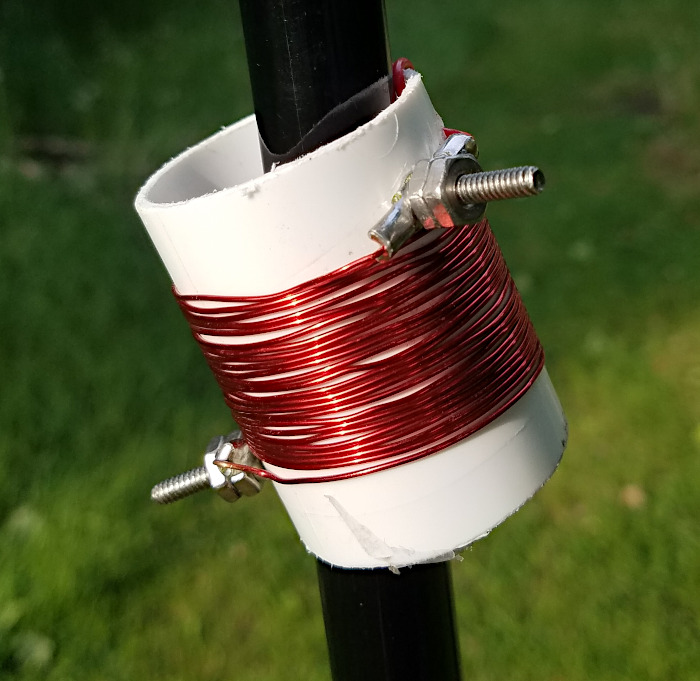
May i know if the radials requires elevation above the ground or just leave it laying on the ground?
Hello,
I always lay them on the ground simply because it is easier. If the radials are elevated, it will perform better. Even though elevating the radials gives better performance, I have not been disappointed with this antenna’s performance with the radials on the ground.
Hope this helps.
— Mike WB8ERJ
Mike
Thanks for the inspiration – I have parts on the way to build one – I’m an antenna neophyte – I noticed you don’t have any kind of transformer or inductor on the antenna input – is this simply a function of the loaded vertical design? (Whereas with an EFHW one is needed)
Thanks!
Michael
KD7PTZ
Hello Michael,
Thanks for checking out my blog. You are correct. There is no need for a transformer on a vertical since its impedance at resonance is close to 50 ohms. Actually between 35 and 70 ohms depending on the radial orientation, but not to worry about that. There are too many other uncontrollable factors in the real world of antennas to be concerned with that.
With an EFHW antenna since it is fed at the end of the antenna, the impedance there is 2000 – 3000 ohms. So in order to match the antenna to the coax / rig, you need a transformer on an EFHW antenna to get it down to 50 ohms. Hope that helps.
Good luck with your build – hope to work you someday.
— Mike WB8ERJ
Thanks Mike – I shot you a follow up email to your address on QRZ
Michael
KD7PTZ
Nice article, clear explanations. Looking further on your blog site, lots of nice articles!!!
For the past 2 years I have been loving random length and half wave end fed antennas on 9:1 / 49:1 Ununs. Really supriised what 34′ of wire can do add a counterpoise and/or a 1:1 to get rid of the feedline current
Now after reading this my next antenna is going to be a vertical!!!
Hope to work you
73 Ben – ne5B
Thanks Ben for the kind words. Yes I too have used an end fed wire. They work great! Probably better than a vertical. However I find setup and tear down of vertical antenna to be faster and easier with only a slight sacrifice in performance to an end fed wire.
Hope to work you on a POTA activation!
73’s — Mike WB8ERJ
Hello,
Im sorry for stupit question but:
“Diameter of the CONDUCTOR in inches”, from “Coil-Shortened Vertical Antenna Calculator”
Diameter of conductor – means the diameter of the lower and upper wire connected to loading coil, or diameter of the cooper wire used from loading coil ?
Many Thanks .
Martin
Hello,
I can see your point of confusion. “Diameter of conductor” means diameter of the coil.
Good luck!
— Mike
Many thanks for the clarification Mike.
Martin, OK5MCA
You are welcome!