 Fellow hams, if you think packet radio is a relic of the 1980s and 90s BBS era, it’s time to tune in again. This resilient digital mode is experiencing a notable resurgence, driven by its proven reliability in off-grid scenarios, modern software tools, and renewed interest in resilient emergency communications.
For operators who remember connecting to distant nodes with clunky TNCs, everything is now done with software. All you need is a computer with a sound card, free modem / TNC software such as Direwolf, and you are good to go. I have several Packet stations running on Raspberry Pi’s. My WB8ERJ-1 packet BBS runs on a Raspberry Pi 3B+ and a USB sound card.
Why The Comeback?
Packet radio, built on the AX.25 protocol, breaks data into packets for efficient transmission over VHF/UHF (and sometimes HF). While the internet boom reduced its everyday use, recent events—natural disasters, infrastructure concerns, and a broader focus on grid-independent operations—have highlighted its value.
Modern implementations use sound card modems like DireWolf, and software such as BPQ32, making setup far easier and more powerful than the hardware-heavy days of old. Clubs and regional networks are reviving or expanding packet infrastructure, with active BBS systems and forwarding links.
Here is a map of some of the Packet BBS nodes in Ohio. For a complete list, OhioPacket.org has a list by county.
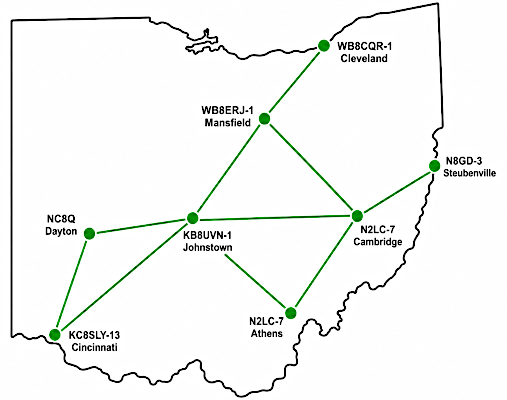
Operators report renewed activity on traditional frequencies like 145.010 MHz for BBS traffic. High-profile emergencies have demonstrated packet’s role when cellular and internet services collapse. The WB8ERJ-1 BBS is on 145.030 mHz in the Mansfield Ohio area with a backhaul link on 223 mHz to KB8UVN-1 in Johnstown as well as to KD8FTR-1 in Ashland Ohio.
[…] Packet radio is making a strong comeback If you think packet radio is a relic of the 1980s and 90s BBS era, it’s time to tune in again. WB8ERJ […]